ENG
.
The Augsburg Royal Historic Center
.
Historical visit of the center of Madrid, known as the Madrid of the Habsburgs.
On this walking tour we will explore the relationship between history and architecture, and we will learn about the Islamic origins of this city, its origin as a medieval village, and how it developed into a imperial capital home of two royal houses:
The Austria – Augsburg royal family (16th – 17th centuries) influenced the Herreriano Baroque. Later, the Bourbon house preferred to modernize the city through the Franco-Italian Classicist Baroque.
During the visit, we will see various architectural styles from different periods. We will analyze these styles. This includes the Medieval Mudejar style. We will also discover historical ruins hidden in the subsoil.
A whole world and a fascinating story to discover!
Historical Details of the City and buildings / places included. Read more…
.
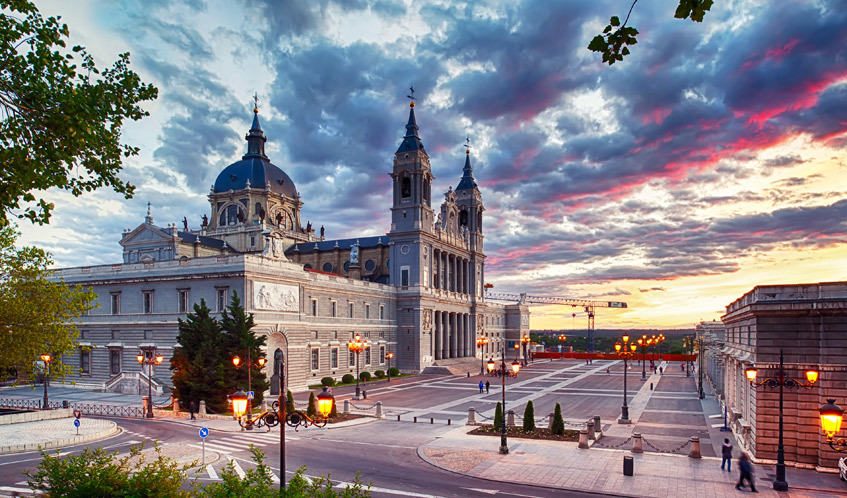
Madrid was only a village when the Arabs took over the Iberian peninsula in the 8th century. During the 9th century Mohamed I constructed a fortress over the Manzanares River, strategically positioned overlooking a pass in the mountains, in order to protect Toledo from the Christians arriving form the north. We can now see some ruins of its wall south of the Royal Palace, on the other side of the cathedral of the Almudena next to it.
.
The Royal Palace was constructed later by the Bourbons in the 18th centruy and it was the official residence of the royal family till 1931. In the present, it is only used by the king in oficial receptions. The royal family has moved to a palace in the Monte del Pardo, north of the Madrid River Project. The weading of the prince of spain took place in this cathedral and the banquet in the palace.
.
But any way, lets go back to the past. In the early 11th century (1083) Alfonso the VI recovers Madrid from the Arabs and the tradition tells that as he entered the village he discovered the image of the virgin on a “almudín” (a basket to store wheat). So, he transformed the mosque into a church and dedicated it to the virgin of Almudin, this way the virgin of the Almudena became the saint and protector of the villa.
.
From the 14th century Madrid started gaining popularity. Carlos V reconstructed the Arab fortress for the Austrias, and Felipe II moved in the 16th century the Royal Court here from Toledo. Its population multiplied then by three to 60,000 habitants, and gates to nearby cities were built as it is the case of the gate to Segovia or Toledo. This was a period of relative political stability and the Spanish empire flourished. Madrid was declared capital in 1561.
.
Calle Mayor (Spanish for Main Street). Its name indicates the importance of the street itself. The Italian Institute of Culture is an old 17th century palace. In front of it we find the old Palace of Uceda, from the same period and now days headquarter of the Capitanía General.
.
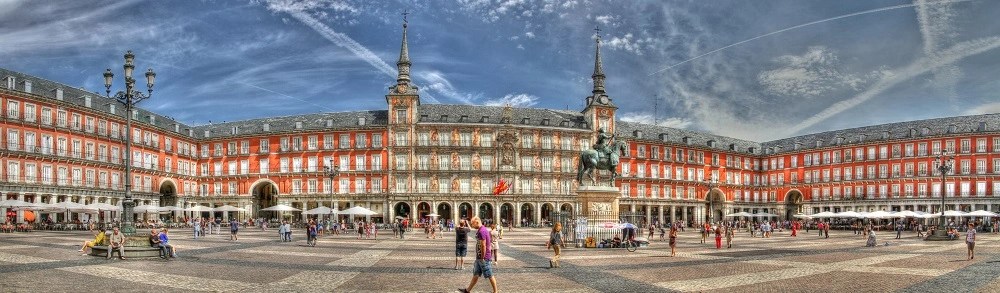
The Plaza of the Villa is a quiet pedestrian plaza which hosts the old City House by the architect Gomez de Mora dates from the early 17th century. In that period, Felipe the III moved for the royal court to Valladolid for a couple of years. When the court returned to Madrid in 1606 Gómez de Mora wanted give a fresh look to the villa in order to lose its medieval atmosphere. The Plaza Mayor was its most important transformation, becoming the new centre for Madrid. In that period of time, many temples churches and convents were built by Felipe the IV, who was a profound lover of the fine arts that promoted painters like Velázquez or Murillo.
.
The Market of San Miguel, built in the beginning of the 20th century with its typical iron structure has being recently refurbished, offers the most fancy tapas that can probably be found today in Madrid.
.
Indeed, we are at the Augsburg district, full of small streets, passage ways, monasteries and churches, as we´ve seen, an area of medieval origin that developed around the Plaza Mayor.
.
The Puerta del Sol is the most popular and animated plaza of the capital, not only a place where cross roads meet but also the Km. 0 to all mayor national roads. Here we also find a monument, an important symbol of Madrid, the bear and the strawberry tree (which is a local tree with red small fruits).
.
This is the Plaza of Tirso de Molina, who was a 16th century poet. A couple of blocks south of here, on Sunday mornings we have the Rastro, a popular street market were you find all kinds of interesting objects and antiques.
.
This is Lavapies district that dates to the to the 17th century. Here we find typical communal buildings with a corralas in the interior patios, exterior terrace type corridor similar to those we can seen in contemporary social housing promotions in PAU of Carabanchel or Vallecas districts. Historically it has always received diverse population, youth and a great number of immigrants.
.
The Huertas district his famous for being also in the 17th century a neighbourhood for writers. Now days it has become a pedestrian full of restaurants and bars, quite lively at night.
Details:
- Starting Point: Plaza de Isabel II (Metro Opera)
- Duration: Between 2,5 – 4 hrs
- Language : English, Spanish and others upon request.
.
Walking itinerary:
Photos:




.
Video material by Prof. Carlos Alberto Hernández Correa (Javeriana University of Bogotá, Colombia)
.
For + INFO or to make a reservation:
.


.
 Pure Expeditions