.
Detalles:
- Date : Friday 12th of April 2024
- Starting Point: Green Patio 13:30 hrs
- Finish Point: Hotel VP Plaza de España 16:00 hrs
- Language: English / German
- Duration: 2.5 hrs
- Participants: 11
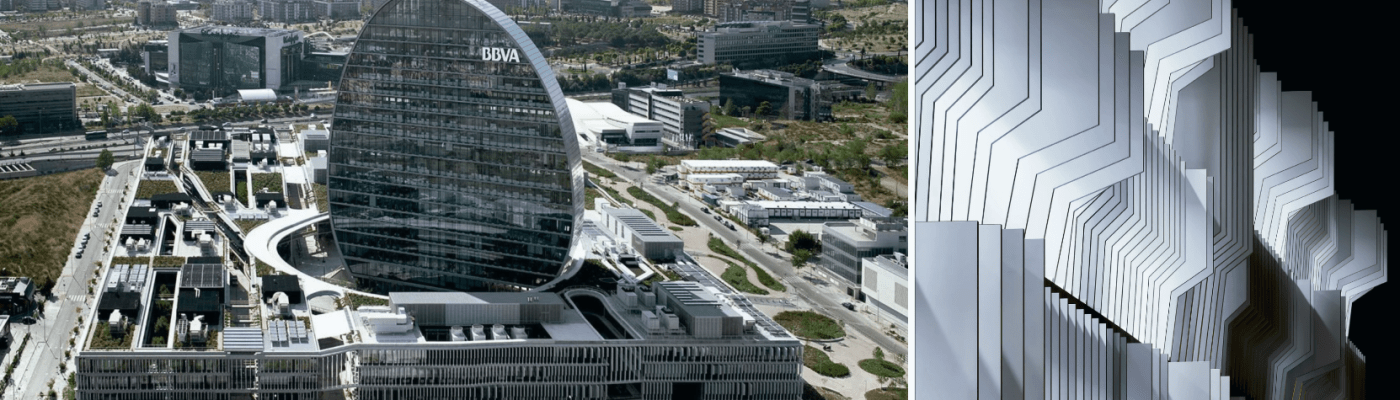
Abstract: En este tour visitará la nueva sede del segundo mayor banco español “BBVA”, que constituye un hito arquitectónico en términos de arquitectura sostenible y promotora de la comunidad.
El proyecto fue diseñado por el renombrado estudio suizo Herzog & de Meuron y se inspira en el modelo de urbanización de la historia, en el que las ciudades y los pueblos se construían en torno a las personas y las necesidades de la comunidad.
Primero viajará en autobús durante unos 20 minutos hacia el norte de la ciudad, pasando por otros ejemplos de la especial arquitectura madrileña. Una vez que llegue al “BBVA”, le espera una visita guiada de una hora y media por el complejo, durante la cual no sólo aprenderá detalles sobre los antecedentes y el desarrollo, sino también más sobre cómo una de las mayores instituciones financieras de España implementa el Nuevo Trabajo en conceptos espaciales que marcan tendencia.
Program
13:15 Cita en Green Patio para entrega de carteles.
13: 30 Depart to City BBVA (La Vela) at Las Tablas District
Before we arrive at Ciudad BBVA, as we drive north through Castellana Axis and as we arrive at las Tablas, we will be passing by and explaining from the bus the following three buildings:
Kio Towers (1990-95) by Philip Johnson. Read more…
the buildings began to be erected in 1990 according to the design of the New York studio Philip Johnson & John Burgee Architects and were completed in the fall of 1995. They lean to become a landmark on the main Castellana Axis. The effect is of a Gate or Entry, also known as Puerta de Europa, or main entrance to Europe, conection between marroco and nothern part of Europe (Belgium, adn so on). Resemblance with PPG Place, glass castle in Pittsburgh with red grid on the facade.
Four Towers Business Area (2004-09) by Norman Foster, Carlos Rubio, Cesar Pelli y Henry Cobb. Read more…
Their construction began in 2004 and the completion of the towers occurred in stages: the Espacio Tower by Pei Cob Freed & Partners (US with sutdio in New Yor), main architect Henry Cobb saw the light at the end of 2007. 2. The Glass Tower by Cesar Pelli (also US) at the beginning of 2008 and has a garden in the upper part interior. The Cepsa Tower by Norman Foster in mid-2008 and the PwC Tower or Eurostars Tower by Caros Rubio Carvajal y Enrique Álvarez Sala, worked on solar and heat control, as we put sun glasses and a hat to protect our selves here in Spain, was the last of the four towers and finished at the end of 2009. It has an interesting way to land on the ground, as in a hole, it seems not to end anywhere, and uses also an interesting mixed concrete and steal structure developed by the engineering firm MC-2.
.
.
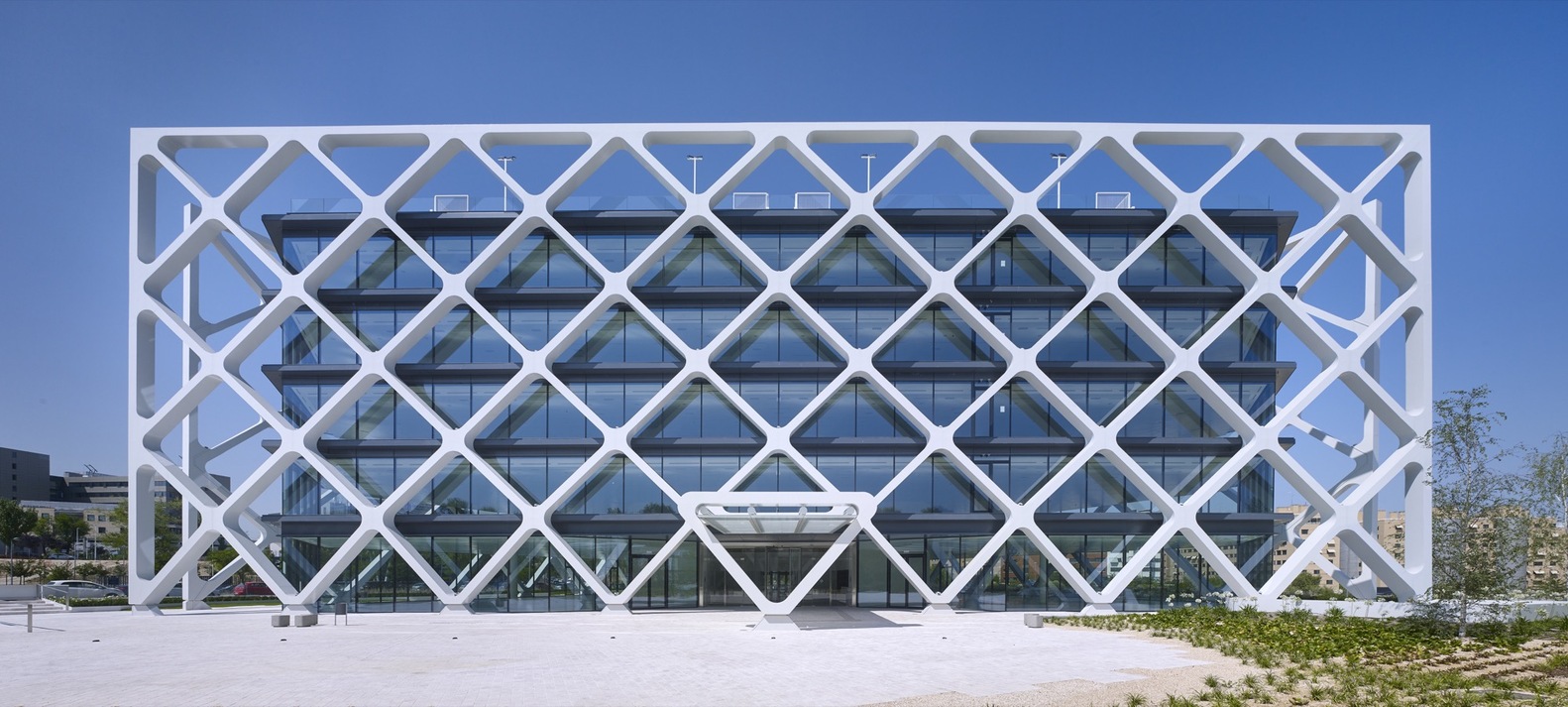
Oxxeo Office Building (2018) by Rafael de La-Hoz. Read more…
Oxxeo Building has emphasis in its free-standing construction with a triangular plan where the supporting structure of the slabs is extracted to the outside, configuring a large latticework that protects of solar radiation.
The office building has an above-ground area of 14,299 square meters distributed over five floors, as well as two underground floors with 450 parking spaces. The complex is crowned by a roof that includes sports facilities that hopefully we will be able to visit (permission in process to be granted by Gmp, owners of the building).
The construction has obtained the LEED Platinum Core & Shell certification, the highest distinction awarded by the US Green Building Council (USGBC), and the five-star DIGA (Distinction Indicator of the Degree of Accessibility) accessibility certification, from the Shangri-La Foundation.


After Oxxeo Bldg, we can start introducing from the bus through the microphone of our main visit, the New Headquarters BBVA Bank (2007-15) by Herzog & de Meuron, perhaps one the best large contemporary architectural projects in Madrid, design by Jacques Herzog & Pierre de Meuron, architectural studio based in Basel, Switzerland – 2001 Pritzker (Architectural Nobel) Price.
13:50 Arrival at Main Gate City BBVA. From the exterior we will explain the facade and the relationship to the sun, including the La Vela (Sail) Tower. Read more…
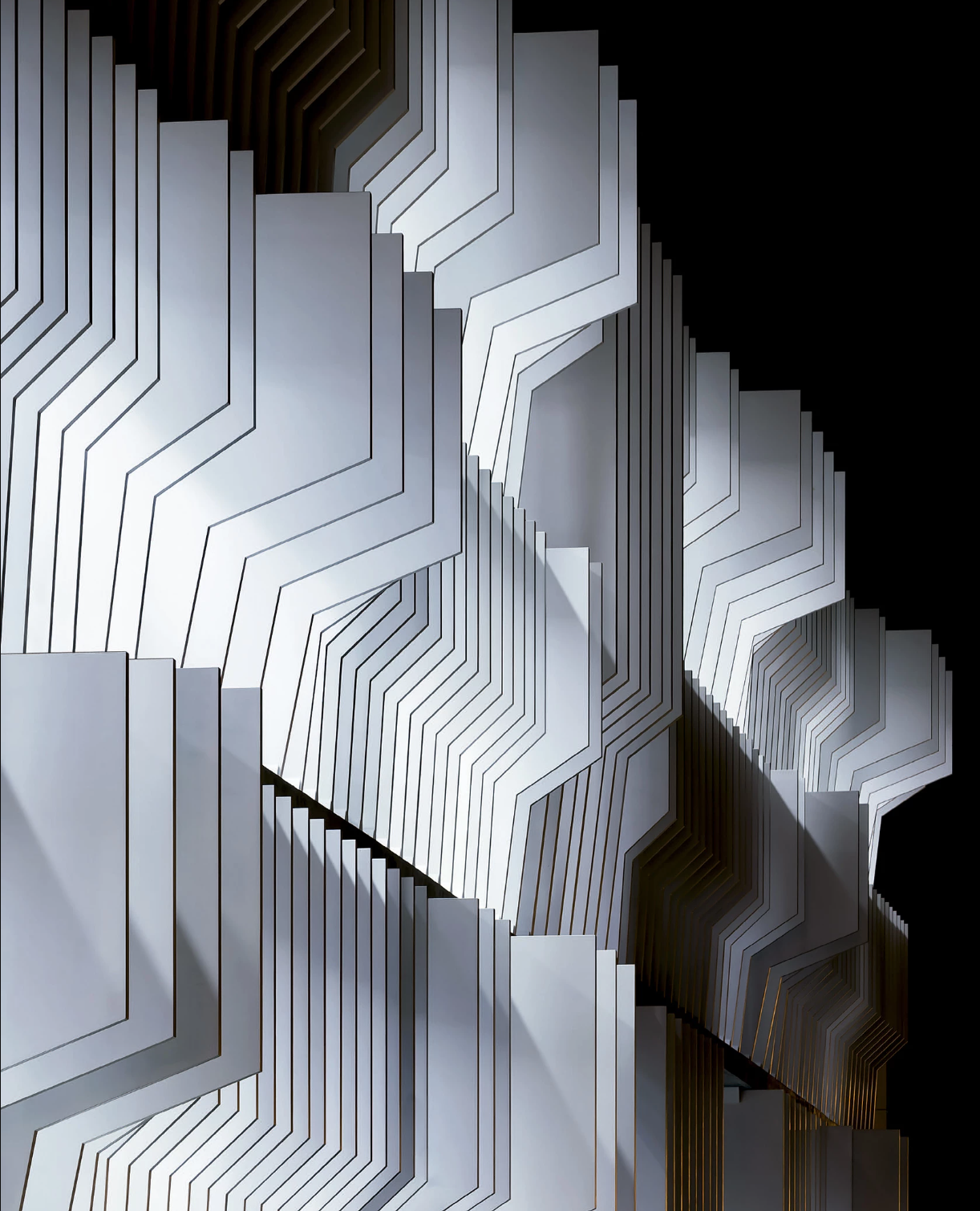
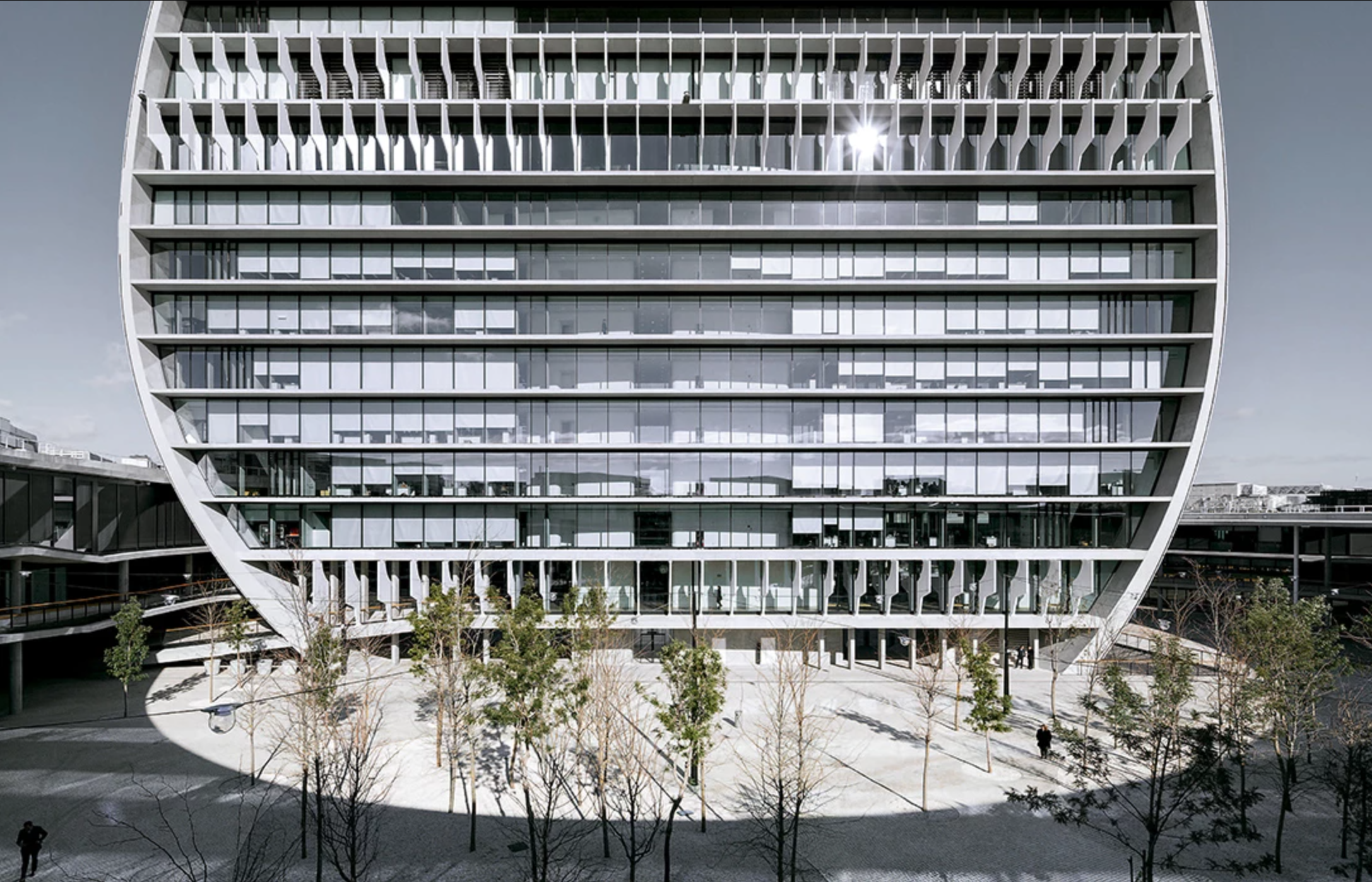
A whole new complex that integrates several pre-existing buildings on site that were in a good condition. Around are buildings are unified by a linear continues facade that is a very original compositions ir irregular, still “aerodinamic” brise-soleis. This is a solar protection system of beautifull aesthetics.
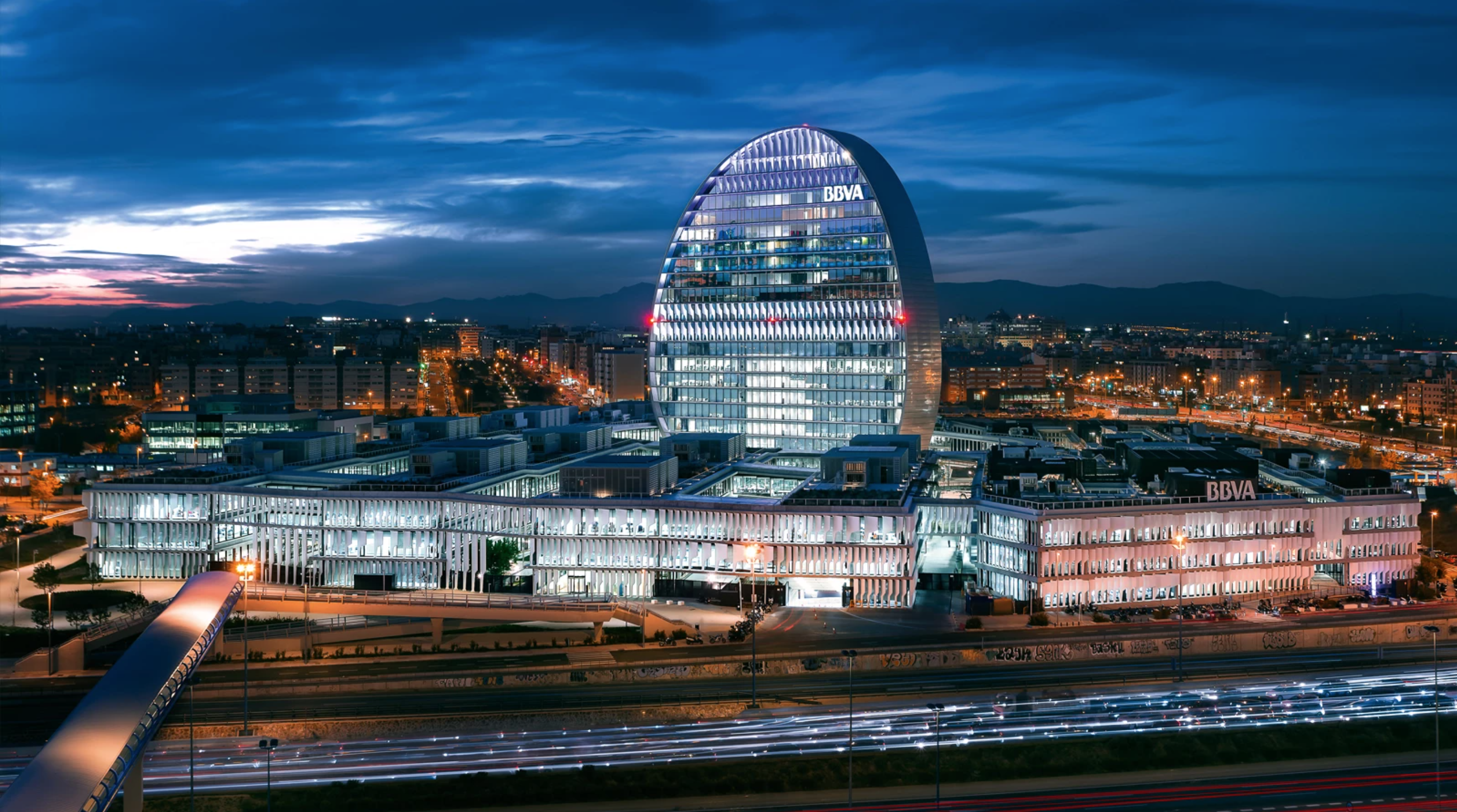
In its interior stands out a major circular plaza, the main public space for the complex, with a transparent , also circular high rise building, which has become a landmark for the territory known as the “sail ” (in Spanish vela) of a sail boat. It’s orientated in relation to the sun path, to minimice sun exposure during the summer season.
14:00 to 15:30 interior visit to the BBVA Financial City.
We will be received by Gilbert Mateu, Public Affairs and Institutional Relationships that will talk as we move through the interior to the group. From this point, the visit is not so much about architecture, although brush strokes (pinceladas) about architecture can be added by the guide.
He will lead the explanations that will be in english and can be translated into german for those that need translation by the guide.
Recorrido por el interior de Ciudad BBVA:
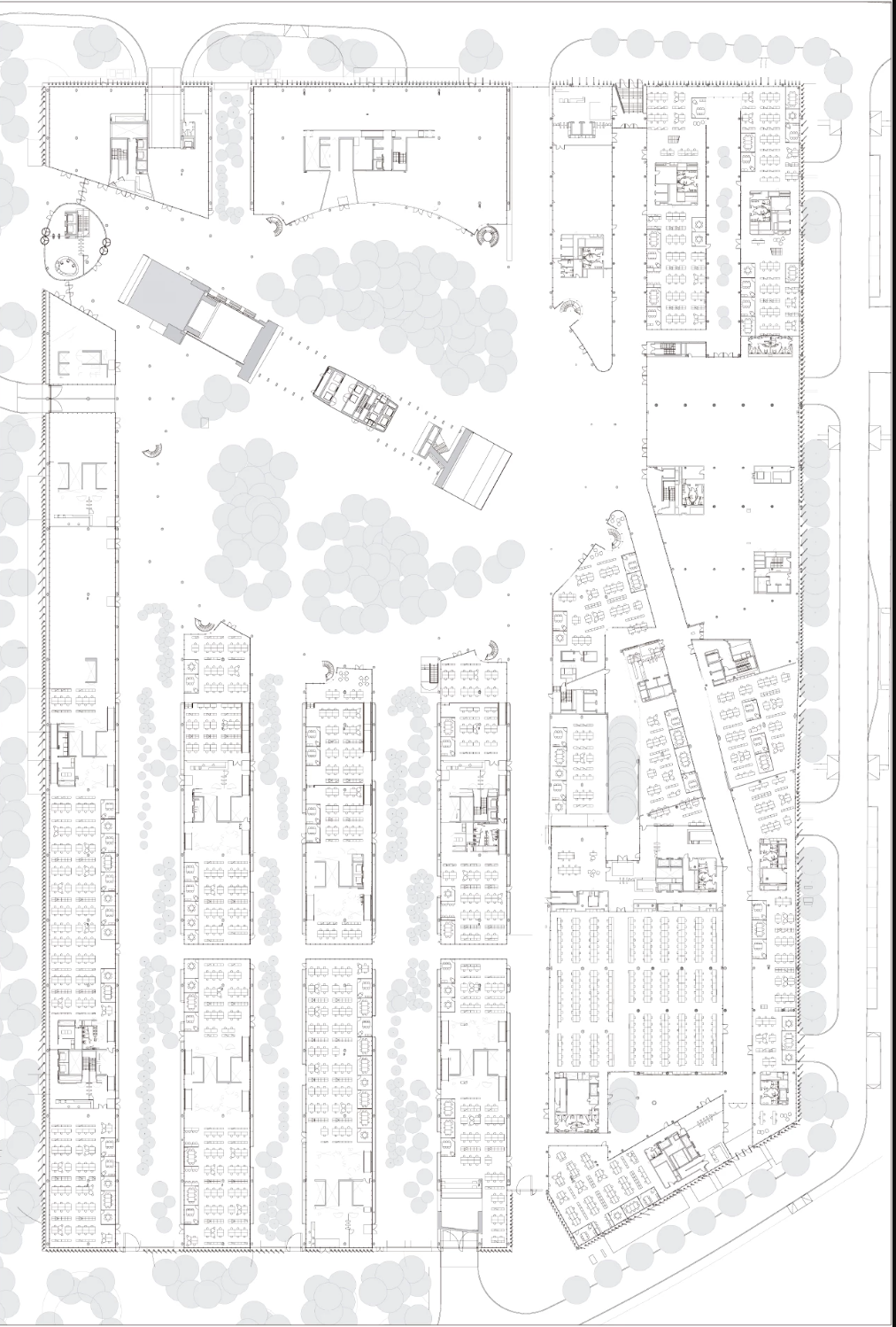
We will go on an interior tour first to the major circular plaza, where there is a place perfect to take photos with seductive architectural curves and the interior streets are full of peaces of art. Then we will go up to the high rise building from were we will get a general perspective and from this position we will have a broad idea of the scale of this project. A campus designed for 6,000 employees, nowadays because of the new online work system, holds daily around 3,500 employees. In the high-rise building we have only a small proportion of employees, that is only 250 inside the Sail.
From this perspective we can see the space between the buildings, like in a green city in itself, are corridors, patios full gardens and streets. Because this project was design by an european estudio (vs. City Santander Bank which was design by an American studio) it is a city to be walked, to be experience by foot. Pedestrian spaces, green places to meet, vs. the American paradigm as in the city of Bank Santander, were employees move by car between the city buildings (and its relation to carbon emissions, etc…).


Contenidos del mensaje de Gilbert:
He will give his based on values and explain how change in the financial digital world has required us to change at a personal level, which is necessary to achieve sustainability on both socially and financially.
How this is a great opportunity because although there are great European funds, these are not enough. It is required to stop producing carbon emissions. The carbon transformation requires a change of chip, a change of paradigm.
City BBVA is a response to this need for a new carbon free paradigm, a healthy and sustainable life style. It is once again, a sustainable project, LEED (Leadership in Energy and Environmental Design) prince winner, thanks to the use of technology. As an example, the type of glass used in the facade allows light to enter the interior but not the heat.
At the end, o durante el recorrido, we expect to have a Coffee break, a moment for dialog, know each other better allowing networking between participants.
15:30 We exit towards the bus which will pick us up at main gate and depart towards VP Plaza Hotel
16:00 Tour ends at hotel VP Plaza España
.
 Pure Expeditions