
.
- 13 km total (2 hours)
Royal Palace: 18th Century. Baroque.
Catedral: Neoclasic (exterior) started construction end of 19th century (1883), finished 100 years later end of 20th century (1993).
Gallery of Royal Colections (museum) contemporary architecture design by Emilio Tuñon and Luis Moreno Mansilla. Construction started 2006 and finished 2015.
Principe Pio Station: Also known as North Station. Front bldg 1928 Style Art Deco.
Madrid Rio 12km urban development, competition 2004 completed 2007 won by M-Rio Architects.
This 2004 international competition was won by the Design Team M-Rio Arquitectos which was composed by West 8 (landscape architects from Rotterdam) as responsible for the masterplan and Rubio & Alvarez-Sala + Burgos & Garrido (Gines Garrido General Director)+ Porras & Lacasta, three top local Spanish architecture studios that took care of the design and detailed partial plans.
Completed in 2007, the Burial of the M-30 ring road provided a marvellous opportunity for Madrid to transform itself. It has allowed the banks of the Manzanares River that used to be on the surface occupied by a highway that run parallel on both sides of the river banks to be recovered completely.
On one side, the traffic has being re-conducted underground through a system of tunnels that span more than 12 km in length, that have solved not only the traffic of the territory, but on the surface recovered the ecological system while improving the live quality of not only those leaving next to the River, but also, those in the other parts of the city that now come to enjoy this now healthy, clean and quiet natural space that is now full of live.
It is now a new natural system that at different scales, has integrated new, and remodelled previous, structures and bridges, public spaces, and historical parks, and other pre-existing buildings and municipal facilities that have been now transformed into cultural facilities that are well worth visiting. These are, together with some historic and 17 new singular pedestrian and bicycle walkways / bridges.
Refurbished and remodelled dams: 7 in total. The Madrid Río dams, built in the 1950s, date back to the Madrid Urban Development Plan of Franco’s dictatorship. Stylistically, they adopt a Herrerian style, with ornamental details reminiscent of the imperial architecture of Philip II. Their purpose was to regulate the river’s course and create the appearance of greater flow.
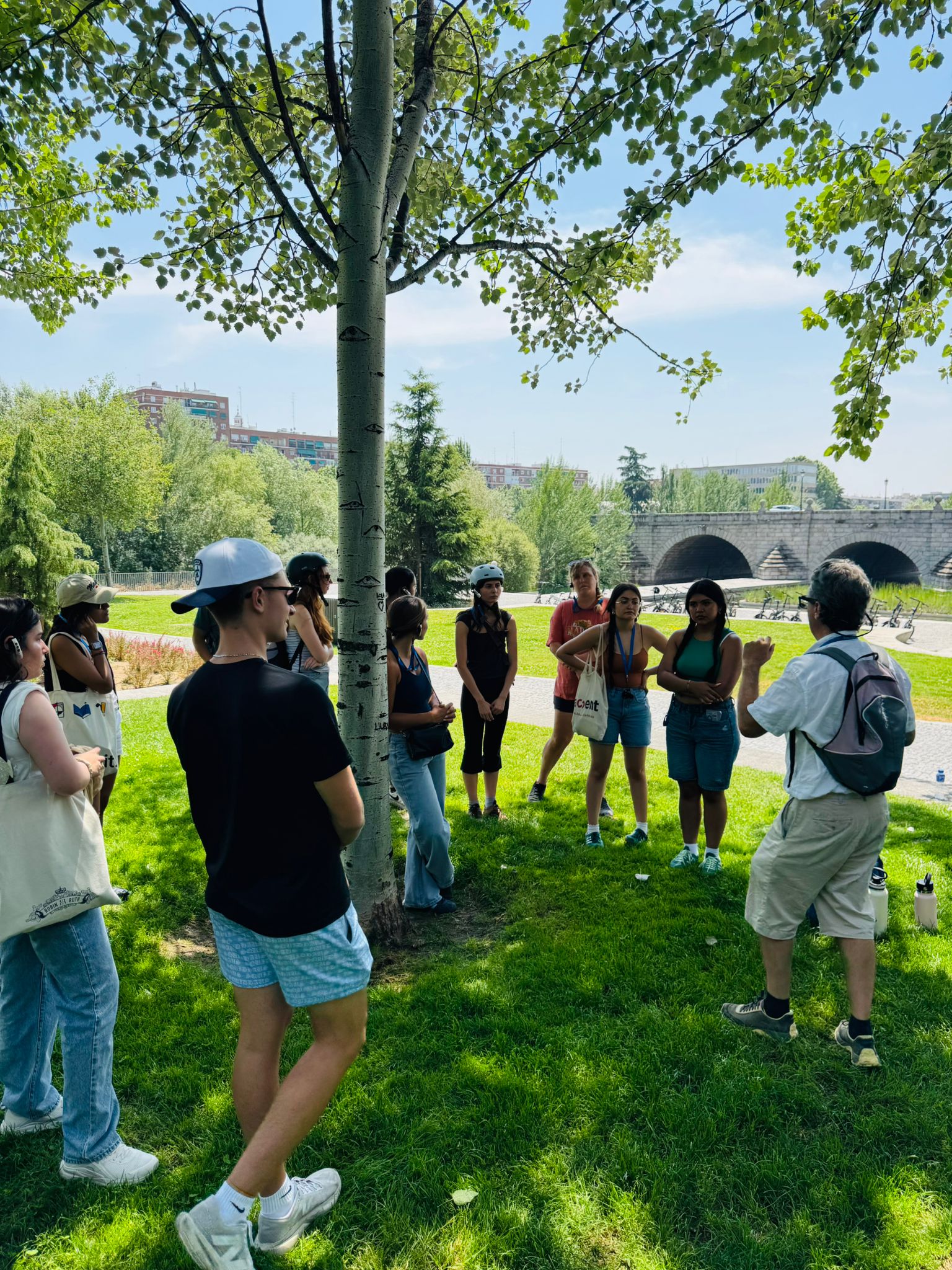
Segovia Bridge: Renaissance style and was built in the second half of the 16th century, specifically between 1582 and 1584, by the architect Juan de Herrera.
The Center of Hydrographic Studies by Miguel Fisac. In its interior we find a very interesting and beautiful bone beam roof structure designed and constructed by this by the Spanish master architect of the 70s, with a beautiful and sophisticated use and control of natural light that inundates the interior space.
Toledo Bridge built in the Churrigueresque Baroque style and was built in the 18th century, specifically between 1719 and 1732. It was designed by the architect Pedro de Ribera and is considered one of the most representative works of Madrid Baroque.
The Arganzuela Bridge 2011 (also known as Perrault Bridge) which is displayed in cover photo of this page, is located in the central part of the Arganzuela Park. It has an important presence, can be seen from the distance, beautifully lighten at nigh. Designed by French Architect Dominique Perrault in 2011, it costed costed about 13.6M€ it is composed of two tubular steel segments that span 278 m, allowing pedestrian and bicycle circulation from the south to the north river bank and viceversa. This transitional space large enough to incorporate in his interior, and in between its segments, public space.
Obelisk of the Castellana Fountain, also known as the Obelisk of Arganzuela. It was originally a monumental fountain commissioned by Ferdinand VII to commemorate the birth of his daughter Isabella II in 1830, although it was finally erected to celebrate her third birthday. The column is crowned with a bronze star.
Shell bridges (2007-2011) by West 8, designed as heavy concrete domes with a rough structure, are in them selves a piece of art with, one hundred cables carry the delicate steel deck as if they were whalebones. The interior domed ceiling displays the artwork of the Spanish artist Daniel Canogar. The lighting incorporated in the edges of the ceiling illuminates the artwork and the deck by reflection. These shell bridges connect the the Arganzuela Park, on the Slaughterhouse side, with the Salon de Pinos with will lead us near, on the other side, to the popular Usera District
The Old Slaughterhouse was designed and constructed by the Municipal Architect Luis Bellido in 1908-1928. However, it was only in 2005, when the special development plan was fixed to allow architectural development of the site, that it was truly transformed, and included some of very interesting contemporary parts, it is now a hub for cultural events and spaces that we will be able to visit. The most interesting parts that we will focus in are:
- Itermediae, by Arturo Franco who was responsible for renovating the principal naves of slaughterhouse and the lobbies. In this refurbishing project which cleaned the interior spaces and left them pretty much intact, dominated the use of iron and glass as the main new materials employed in this, still strong and clear, but minimal intervention, which influenced the later projects to come such as:
- La Casa del Lector (the Readers Home) a fine contemporary project that integrates two naves by the beautiful use of large steal beam / brides and glass, designed by Gª Abril (we may say, she was also influenced here by Arturo Franco).
- Finally, the later Film Library and Cinema by the Jose María Churtichaga is a very different to those previous projects and that stands out for the innovative way to light up the interior space. He used of a simple water house that integrates a led light system to illuminate the interior of the main cinema projection space, also the staircase that leads to the film library. Worth visiting, for its contemplation, in our full 4 hour tour.
Q&A
.
Interview made around 2013 to Jose Antonio Catalayud, City Council’s Civil Worker involved from the beginning in the whole process of the Madrid River Project:
.
1. The background to the project and how the project was gained approval from the city:
.
Everything started eight years ago as an idea the actual mayor had for his electoral campaign. As he won the elections, the project was put forward and structured into two parts:
.
The first part was the burning of the ring road that for more than 12 km invaded both sides of the river. This phase could be done directly although it needed to be approved by two public institutions: The Hydrographic Confederation of the Tajo River and also the Governing Area of Patrimony that depends of the Provincial Community of Madrid. The project was presented to both institutions and the City Council had to negotiate with both of them. This was a very long and painful process that lasted many months, almost a whole year. The Hydrographic Confederation imposed 52 conditions that had to be fulfilled for their approval, including the building of a cleaning (saneamiento) system of the river banks, something they had in mind years before that could not be done due to the lack of budget, which consisted in lifting up the river “box” and the dams of the river. This can easily be distinguished from the old, as the new material employed is solid rustic granite.
.
Afterwards, also the Provincial Community of Madrid presented a series of conditions, for instance rehabilitating a series of pre-existing foot paths and historic bridges like the Puente de Segovia.
.
The second part was to design a master plan for the surface, so an international competition was lunched. It was won by the landscape architect studio from Rotterdam, West 8, working together with other three Spanish architectural studios.
.
Development plans were then prepared for the individual componentes: Salón de Pinos, Avenida de Portugal, Huerta de la Partida, Jardines de Puente de Segovia, Jardines de Puente de Toledo, Jardines de la Virgen del Puerto and Parque de la Arganzuela. The different parks mentioned are part of a master plan connected by pedestrian bridges, and the park connects with other green areas and forests through a bike route.
.
The winning entry was made public and the community made more than 1400 allegations, which around 850 suggestions were considered. Of course, these suggestions made the design teams have to reconsider their designs, in order to solve technical problems that raised.
.
The first parts were completed in spring 2007. while some of them are still being finished, later in a rush to have it completed four months before the original deadline due to the coming political elections.
.
2. The functions of the city during and after the construction of this project:
.
The governing area of urbanism which is part of the city council, controlled the whole process and acted as promoters, management administration, and directed the work on site. The external design teams only assorted them, as the administration was concerned with deadlines and final costs (between 4 and 5 thousand million euros) financed by private banks which the city has to return in a period of around 30 years.
.
3. How has the project affected the city:
.
In the beginning, the burial affected very hard and directly the neighbours that provoked, due to the 24h noise of the works, quite a lot of psychological problems.
.
Now that it is being finished, we still have to evaluate with time how it has changed positively Madrid. The impact is not the park itself but how the territory has being affected with the building of all the new transversal connections and bridges that we will see these days of people activating both sides of the city. Also, at a larger scale, we have this new longitudinal environmental corridor that connects pre-existing parks like, the Pardo Forest with the Magic Box tennis and park in the South, and a much larger scale, it connects through the bike route with the Natural High Tajo River Park.
.
4. What role has the society (community of citizens) had during the process:
.
As we mentioned before, they contributed with more than 1400 suggestions. Throughout the whole process there has being a permanent office and other information points for the citizen where they could go and make their suggestions, some of them were crazy but other were consider and executed, like an urban beach constructed in the Arganzuela Park (underneath the Dominique Perrault foot bridge) that we will see now.


.
 Pure Expeditions