
.
- 8.5 km total (2h 45 min)
- Client: QIK
- Group: 02/04
S. VIII: CONQUISTA ISLÁMICA (año 711)
Emir de Córdoba (Mohamed I) – Funda Mayrit S. IX (año 870)
Alcázar (del árabe alqasr, sirve para definir una residencia real fortificada)
S. XI Alfonso VI REY DE GALICIA CASTILLA Y LEÓN: Reconquista Madrid
S. XVI CASA AUTRIA – ASBURGO (S XVI – XVII) TRASLADO CAPITAL 1561
Debod Temple (II Century) Egyptian temple from the 2nd century BC, now 2200 years old.
The Egyptian government donated the temple to Spain in 1968, in compensation for the cooperation offered by Spain after the international calling of UNESCO to save the temples of Nubia Region in Egypt, mainly the Great Abu Simbel Temple to be floaded after the construction of the Aswan High Water Dam. It was dismantled, first kept in an island of the Nile River and moved to this new location in 1970.
Placed in the same orientation as it was aligned in Debod east / west axis, this is a wonderful spot to come in the evenings to obtain a beautiful sunset overlooking the the Manzanares River and further west the Casa de Campo.
The construction of the temple began at the beginning of the 2nd century BC. by the King of Meroe Adijalamani, who dedicated a chapel to God Amun an egiptian celestial God, God of creation) and Goddess Isis (one of the main Egyptian Goddess that extended to the greco/roman world.
All of this was part of the 62 million euros renovation of this public space (2019-21). Porras Lacasta carried out the project. This architect won the first prize in the ideas competition promoted by the City Council of Madrid. The competition was held under the motto “Welcome mother Nature“.

Royal Palace was constructed in the 18th century, between 1738 and 1764.
- Placed on an islamic fortress, where later was built an alcazar (1537 by Juan Gómez de Mora) which was destroyed on a fire Christmas 1734 (18th century)
- New palace Louvre (Paris) style designed by Filippo Juvara, Sachetti, Ventura Rodriguez, Sabatini (IT) S. XVIII
- Residencia Real 1931, ahora recepciones oficiales – Palacio de la Zarzuela

Teatro Real neoclasic style bult in S. XIX
Urbanismo Pepe Botella S. XIX
Catedral: Neoclasic (exterior) started construction end of 19th century (1883), finished 100 years later end of 20th century (1993).
- Parado hasta mediados del S.XX y se acaba en estilo neoclásico
- Proyecto Original Neogótico Arq. Marqués de Cubas. – Crípta neoromanesque
Royal Collections Museum (2006- 2016) by Tuñon & Mansilla is a contemporary intervention. The clean volume dialogues with the geometry of the facade of the Royal Palace. It brings the set of elements together with the Royal Palace and the Cathedral in a perfect composition. This integration forms a single complex, now perfectly unified and completed. Years after its conception and competition, the museum has been inaugurated in the summer of 2023 and can finally be visited internally.
Palacio Duque de Uceda (Capitanía General). Arq. Juan Gómez de Mora S. XVII
Instituto Italiano, old Abrantes Palace. Arq. Juan Maza S. XVII
- Estilo barroco español, parece un palacio renacentista italiano del S. XVI
- S. XIX se embellece fachada con pinturas,
- S. XX se quitan torreones y se amplía alero
Palacio y Torre de Cisneros. Mudejar S. XIV
Casa de la Villa. Barroco español, Arq. Gómez de Mora S. XVII
Casa Palacio del Cardenal Cisneros S. XVI-XVII
- Plateresco S. XVII (frente) fusión de mudéjar y gótico, considered the first Spanish Renaissance architectural style.
- S. XVI (trasero) relación con Salamanca
Plaza Mayor, Arq. Juan de Herrera S. XVI (Felipe II) Reforma Arq. Gómez de Mora (Felipe III estatua) S. XVII
- Impuestos
- Academia de las Artes.
- Real Academia de la Historia
- Fuegos Sabatini & Villanueva (Borbons)
The Prado Development is a great sample of neoclassic urbanism. King Carlos III with his European ideas, gave Madrid in the 18th century an splendour never seen before. He completely remodelled Madrid equipping it with a public space appropriate for its condition as a capital. For this project he selected the best architects of the Court. Hermosilla, Ventura Rodríguez, Sabatini, Villanueva, planed, cleaned, ornamented and built, a Paseo in the shape of a racetrack, with two big fountains, Cibeles and Neptuno on both extreme, and a third one in the centre, the one dedicated to Apollo (you know, Greek mythological gods and goddesses).
To complete the project, the Botanical Garden, the Academy for Natural Sciences (now the Prado Museum) and the Astronomic Observatory. The boulevard (Paseo del Prado) was used already in the XVI century as a place to go for a walk in the outskirts of the city. It became a social place to meet and being seen, in summary, the perfect place to show off the new Bourbonic ideals.
Caixa Forum (2008) is the result of the transformation of the former Mediodía Power Station, a hallmark of late 19th century industrial architecture that still stands in the city’s old quarter, into Caixa Forum Madrid, its new social and cultural headquarters in Madrid, designed by the partnership Herzog and de Meuron, winners of the Pritzker Architecture Prize in 2001. The transformation was indeed a surgical operation. The Swiss architects demolished the original roof and interiors. They cut away the granite base of the brick exterior walls, creating the illusion that the building floats in mid-air, hovering over a covered entry plaza. A tour of the building will show the contrast between the flexible character of the exhibition spaces and the spatial complexity of the upper floor with its restaurant and offices.

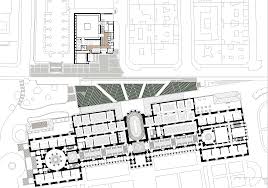
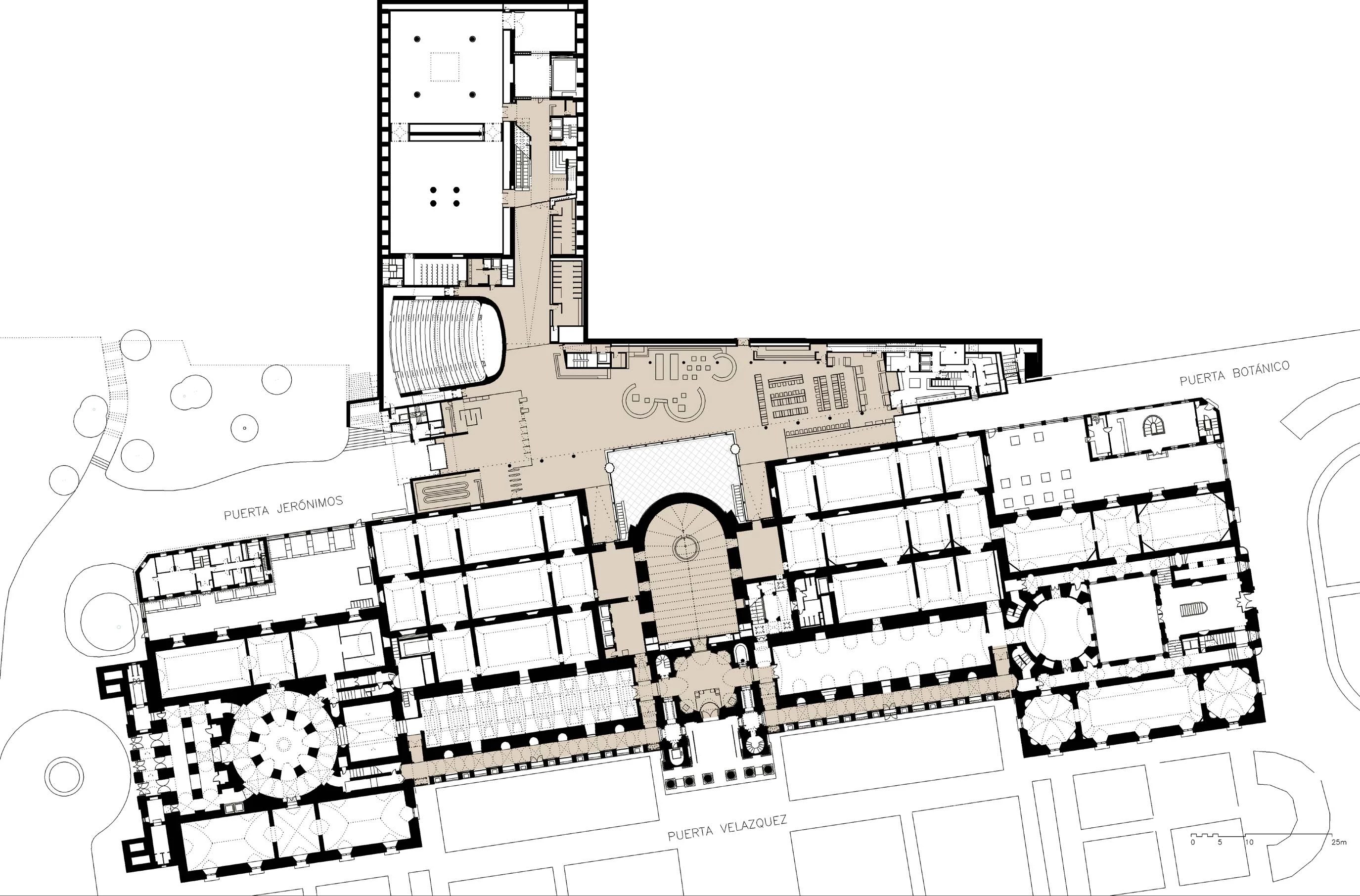
So, the Prado Museum (18th century) was originally not a museum but a the Academy of Natural Sciences. Only later King Fernando VII transformed the project to incorporate the painting collections from the Austria’s and the Bourbons. The new extension to the museum is from 2007 by the Spanish architect Rafael Moneo. It is located in the back of the original building, integrating into the museum the abandoned cloister of San Jerónimo del Real Church (1612). Underneath the cloister Moneo projected a three-story skylight as the central space for the temporary exhibitions that we do visit in the 4h full tour, worth seeing.

This area is one of the most elegant residential area of Madrid, surrounded by señorial buildings, luxury hotels and old places, some of them transformed into museums, like the Thysse –Bornemisza Museum. It is located in what used to be the Villahermosa palace, a neoclassic late 18th century building refurbished by the architect Rafael Moneo in the late 80s to exhibit the magnificent collections that the Spanish Ministry of Culture acquired from the Baron Thyssen.
CIbeles: During the 18th century, noble families started to built palaces surrounded by gardens, like the Buenavista Palace which now is the Headquarters for the Ministry of Defense. It is located in the CIBELES PLAZA. In the center of this plaza we find Madrid’s most popular fountain, also from the 18th century. It is one of the cities mayor symbols, with the Cibeles Goddess ridding a chariot pulled by lions. From here we have great panoramic views framed by the Linares Palace (nowadays headquarters for Casa de América), the Bank of Spain (which is a late 19th century) building extensión by Rafael Moneo, and the and the Communication Palace (1919) by Antonio Palacios.
The Ritz Hotel is an early 20th century (1914), where we see how the classic French style was very fashionable those days. Same thing for the Palace Hotel built in 1912, both grand hotels designed by French architects (by Mevves).
Antonio Palacios’ Role in the Urban Development of Madrid
Antonio Palacios was a prominent architect in Spain. He was influential during the first half of the 20th century. He was responsible for some of the most emblematic buildings in Madrid. His work helped transform the old Baroque town into a modern metropolis.
Antonio Palacios designed and constructed many projects and buildings throughout Madrid. The most important ones are located in the Gran Vía and along the axis of the Alcalá Street. We will focus on these in this tour.
In this area, we find three of the most spectacular and central pieces of his work. They are the Circle of Fine Arts, Commercial Industrial Bank, and the Communication Palace. All three were built by Palacios between 1907-17. We will visit them in depth, including their interiors.
Here, the goal was to alter the street scale. It also aimed to change the public spaces between the buildings that Antonio Palacios designed and constructed. His strategy was to build a sequence of monumental buildings. This would transform the overall scale of the streets. It would also enlarge the public space left in between. All monumental spaces that will give you a very different and impressive perspective of Madrid’s most brilliant modern period.
The result are grand spaces and grand public spaces. Antonio Palacios played a key role in transforming Madrid. His work helped make Madrid one of the main and more modern European cities.
Gran Vía was inaugurated In 1910. Starting in Alcalá Street, finishes in Plaza de España. The Gran Via means Great Route in Spanish. It was built as a fast connection for districts developed in the Project Ensanche. This route links the Arguelles district on the west with the Salamanca district to the east.
At the intersection of Alcalá Street and Gran Vía, we find the Metropolis Building. It was designed in the early 20th century by French architects.
Telefónica Bldg. The Telefónica Building in Madrid, also known as Europe’s and Spain’s first skyscraper, combines elements of modern architecture with Baroque and neoclassical influences. Its design, inspired by New York skyscrapers, reflects a transition toward modern architecture in Madrid.
On January 1, 1930, the construction of the Telefónica building on Gran Vía was completed. The project was carried out by Luis Ignacio de Cárdenas, architect of the Telefónica company, who completed it within three years, following the parameters of the great North American skyscrapers and the premises of International Telephone and Telegraph (ITT), an American company involved in the creation of the Telephone Company in 1924.
Currently houses offices and cultural spaces.
Plaza of Spain (Plaza de España) is home to tall towers like the Torre de Madrid (Madrid Tower). These towers dominate the plaza. Towers like the Edifice of Spain (Edificio de España) were constructed in the 1950s. They served as a classic hotel and commercial gallery. These constructions contrast with other contemporary hotels in the same square. In the center we will find a statue dedicated to Miguel Cervantes and his famous novel “Don Quixote”.
 Pure Expeditions