
.
S. VIII: CONQUISTA ISLÁMICA (año 711).
- Emir de Córdoba (Mohamed I) – Funda Mayrit S. IX (FUNDACIÓN 870)
- Alcázar (del árabe alqasr, sirve para definir una residencia real fortificada)
- Un moro es de el grupo de musulmanes del norte de África que gobernaron en España y Portugal entre 711 y 1492.
S. XI Alfonso VI REY DE GALICIA CASTILLA Y LEÓN: Reconquista Madrid (año CONQUISTA CIUDAD 1.082)
S. XVI CASA AUTRIA – ASBURGO (S XVI – XVII) TRASLADO CAPITAL 1.561
Plaza de Opera. La Plaza de Isabel II, también conocida como la Plaza de Ópera, fue promovida por la reina Isabel II como parte de las obras de construcción del Teatro Real. La reina impulsó la ordenación urbanística de la zona, incluyendo la creación de la plaza, que se inauguró junto con el teatro en 1850, coincidiendo con su cumpleaños.
Estatua Isabel II, amiga de Enrique de Leguina y Vidal (Madrid1842 – Madrid 1923) was a Spanish historian and politician, member of the Royal Academy of History and senator in the Cortes of the Restoration. He held the noble title of First Baron of Vega de Hoz.
Born in 1842,he devoted himself to the study of Spanish history and art. A member of the Madrid Bar Association and the Economic Society of Friends of the Country of Seville, in 1891 he received the Barony of Vega de Hoz from Regent María Cristina, as well as the Greatness of Spain. In 1901-1902 he was appointed senator by the Economic Society of Seville. He also supported the position of civil governor of the provinces of La Coruña, Seville and Córdoba. In 1914 he was elected academic of the Royal Academy of History and was also a member of the Hispanic Society of America, as well as official chronicler of Santander.
He married for the second time in 1902, María Josefa Dávila-Ponce de León y Cea, eighth Countess of Guadiana. They had no children. He died on November 25, 1923.
Teatro Real neoclasic style built in S. XIX
Plaza of Spain (Plaza de España) is home to tall towers like the Torre de Madrid (Madrid Tower). These towers dominate the plaza. Towers like the Edifice of Spain (Edificio de España) were constructed in the 1950s. They served as a classic hotel and commercial gallery. These constructions contrast with other contemporary hotels in the same square. In the center we will find a statue dedicated to Miguel Cervantes and his famous novel “Don Quixote”.
Urban Development All of this was part of the 62 million euros renovation of this public space (2019-21). Porras Lacasta carried out the project. This architect won the first prize in the ideas competition promoted by the City Council of Madrid. The competition was held under the motto “Welcome mother Nature“.

Debod Temple (II Century) Egyptian temple from the 2nd century BC, now 2.200 years old.
The Egyptian government donated the temple to Spain in 1968, in compensation for the cooperation offered by Spain after the international calling of UNESCO to save the temples of Nubia Region in Egypt, mainly the Great Abu Simbel Temple to be floaded after the construction of the Aswan High Water Dam. It was dismantled, first kept in an island of the Nile River and moved to this new location in 1970.
Placed in the same orientation as it was aligned in Debod east / west axis, this is a wonderful spot to come in the evenings to obtain a beautiful sunset overlooking the the Manzanares River and further west the Casa de Campo.
The construction of the temple began at the beginning of the 2nd century BC. by the King of Meroe Adijalamani, who dedicated a chapel to God Amun an egiptian celestial God, God of creation) and Goddess Isis (one of the main Egyptian Goddess that extended to the greco/roman world.
Royal Palace was constructed in the 18th century, between 1738 and 1764.
- Placed on an islamic fortress, where later was built an alcazar (1537 by Juan Gómez de Mora) which was destroyed on a fire Christmas 1734 (18th century).
- El incendio del Real Alcázar de Madrid se produjo en la Nochebuena de 1734, cuando la corte estaba en el Palacio del Pardo. El fuego se originó en el aposento del pintor de corte, Juan Ranc, y se propagó rápidamente, sin que pudiera ser controlado.
- New palace Louvre (Paris) style designed by Filippo Juvara, Sachetti, Ventura Rodriguez, Sabatini (IT) S. XVIII
- Residencia Real 1931, ahora recepciones oficiales – Palacio de la Zarzuela
- Estatuas de Moctzuma, emperador Azteca (Izquierda) y Atahualpa, emperador Inca (derecha) y en la cota cero representaciones de los emperadores romanos Trajano y Arcadio, junto con las figuras de Honorio y Teodosio (realizadas por Felipe de Castro y Juan Domingo Olivieri).
- Gelería esquisita colección de armaduras (royal and feudal armors)
- Plaza de Oriente (Juan Bonaparte) con estatuas Reyes Visigodos (de origen germánico del S. V al VIII)

Catedral: Neoclasic (exterior) started construction end of 19th century (1883), finished 100 years later end of 20th century (1993).
Royal Collections Museum (2006- 2016) by Tuñon & Mansilla is a contemporary intervention. The clean volume dialogues with the geometry of the facade of the Royal Palace. It brings the set of elements together with the Royal Palace and the Cathedral in a perfect composition. This integration forms a single complex, now perfectly unified and completed. Years after its conception and competition, the museum has been inaugurated in the summer of 2023 and can finally be visited internally.
- Parado hasta mediados del S.XX y se acaba en estilo neoclásico
- Proyecto Original Neogótico Arq. Marqués de Cubas. – Crípta neoromanesque
Urbanismo Pepe Botella S. XIX
Palacio y Torre de los Lujanes. Mudejar S. XV
Casa Palacio del Cardenal Cisneros S. XVI
- Plateresco S. XVII (frente) fusión de mudéjar y gótico, considered the first Spanish Renaissance architectural style.
- S. XVI (trasero) relación con Salamanca
Casa de la Villa. Barroco español, Arq. Gómez de Mora S. XVII. Slate (pizarra) roof tiles. Former Town Hall of the City of Madrid (1693-2007). Despite differing opinions, the most reliable seems to indicate that its construction began around 1645, based on a design by the architect Juan Gómez de Mora, and was completed in 1693. The gallery of Tuscan columns on the façade facing Calle Mayor is the work of Juan de Villanueva (1789).
Estatue of Alvaro de Bazán y Guzmán (Granada, December 12, 1526 – Lisbon, February 9, 1588), 1st Marquis of Santa Cruz, second-class grandee of Spain, 1st Lord and Marquis of the town of Viso and 1st Lord of the town of Valdepeñas, was a Spanish military officer and admiral of the 16th century.
In Spain, being a “Grande of Spain” is the highest dignity of the nobility, ranking immediately after the titles of Prince of Asturias and Infante of Spain. This dignity is granted by the King and is generally conferred upon a noble title, although it can be granted to a personal title. Grandees of Spain are styled “Most Excellent Lord” and enjoy certain privileges, such as being able to cover their heads (wear a hat) in the presence of the King, unlike other nobles. In short, being a Grandee of Spain implies belonging to the Spanish nobility with the highest dignity and enjoying certain special titles and privileges.
Historically, the Spanish Crown has received funding from various sources, including the nobility and grandees of Spain, especially during times of need such as wars or colonial expansion. In short, being a Grandee of Spain implies belonging to the Spanish nobility with the highest dignity and having certain special treatments and privileges.
Plaza Mayor, Arq. Juan de Herrera S. XVI (Felipe II) Reforma Arq. Gómez de Mora (Felipe III estatua) S. XVII
- Impuestos
- Academia de las Artes.
- Real Academia de la Historia
- Fuegos Sabatini & Villanueva (Borbons)
Plaza de Santa Ana.
- Hotel Reina Victoria: Dicen que Manolete ocupaba siempre la habitación 406 y que en él Luis Miguel Dominguín y Ava Gardner vivieron su apasionado romance. También alojamiento habitual de Ernest Hemingway desde donde escribió “Death in the Afternoon” (published 1932) is a non-fiction book that explores the world of bullfighting in Spain. His research was donde at Cervecería Alemana where he met “banderilleros” (small flags).
- Cervecería Alemana: La cervecería, que fue fundada por alemanes en 1904, se convirtió en un punto de encuentro para artistas, escritores, actores y cineastas durante el siglo XX. Otros personajes famosos que también frecuentaban el lugar fueron Orson Welles, Valle-Inclán y Ava Gardner. En un artículo que escribió para la revista Life en 1960, se refirió a ella como “un buen lugar para tomar cervezas y café”. En ese local, Hemingway acudía como cliente habitual en las décadas de 1930 y 1950 y compartía mesa y copas con la que él llamaba “la mujer más bella del mundo” (Marlene Dietrich, actriz alemana) y también con the bullfighter Luis Miguel Dominguín, entre otras personalidades. A menudo menudo se le veía disfrutando de cervezas y tapas en una de sus mesas junto a la ventana.
- Teatro Español: one of the main theaters and the oldest in Madrid. Su actividad continúa hasta el día de hoy, convirtiéndose, así, en el teatro más antiguo del mundo en cuanto a representación continuada se refiere. First representation in 1583, nowadays (1895) neoclasic. Se caracteriza por una rica tradición que incluye el teatro del Siglo de Oro, con autores como Lope de Vega, Calderón de la Barca y Tirso de Molina, y por su capacidad de integrar elementos del romanticismo y otras corrientes teatrales. Aquí se estrenó en en 1635 a obra de teatro de Pedro Calderón de la Barca perteneciente al movimiento literario del barroco. El tema central es la libertad del ser humano para configurar su vida, sin dejarse llevar por un supuesto destino. Otros escritores del barrio de las letras: Quevedo, Miguel de Cervantes. Cervantes, aunque vivió durante el Siglo de Oro español, que incluye tanto el Renacimiento como el Barroco, se considera principalmente un escritor de transición entre ambos períodos. Su obra muestra influencias de ambas épocas, aunque a menudo se le ubica más cerca del Renacimiento en cuanto a su formación y algunos aspectos de su estilo, pero también con elementos barrocos presentes en sus obras.
Caixa Forum (2008) is the result of the transformation of the former Mediodía Power Station, a hallmark of late 19th century industrial architecture that still stands in the city’s old quarter, into Caixa Forum Madrid, its new social and cultural headquarters in Madrid, designed by the partnership Herzog and de Meuron, winners of the Pritzker Architecture Prize in 2001. The transformation was indeed a surgical operation. The Swiss architects demolished the original roof and interiors. They cut away the granite base of the brick exterior walls, creating the illusion that the building floats in mid-air, hovering over a covered entry plaza. A tour of the building will show the contrast between the flexible character of the exhibition spaces and the spatial complexity of the upper floor with its restaurant and offices.

Estación de Atocha Alberto de Palacio Elissagüe 1888 (P) 1890-1892, Torre Eiffel 1887.
The Prado Development is a great sample of neoclassic urbanism. King Carlos III with his European ideas, gave Madrid in the 18th century an splendour never seen before. He completely remodelled Madrid equipping it with a public space appropriate for its condition as a capital. For this project he selected the best architects of the Court. Hermosilla, Ventura Rodríguez, Sabatini, Villanueva, planed, cleaned, ornamented and built, a Paseo in the shape of a racetrack, with two big fountains, Cibeles and Neptuno on both extreme, and a third one in the centre, the one dedicated to Apollo (you know, Greek mythological gods and goddesses).
To complete the project, the Botanical Garden, the Academy for Natural Sciences (now the Prado Museum) and the Astronomic Observatory. The boulevard (Paseo del Prado) was used already in the XVI century as a place to go for a walk in the outskirts of the city. It became a social place to meet and being seen, in summary, the perfect place to show off the new Bourbonic ideals.
This area is one of the most elegant residential area of Madrid, surrounded by señorial buildings, luxury hotels and old places, some of them transformed into museums, like the Thysse –Bornemisza Museum. It is located in what used to be the Villahermosa palace, a neoclassic late 18th century building refurbished by the architect Rafael Moneo in the late 80s to exhibit the magnificent collections that the Spanish Ministry of Culture acquired from the Baron Thyssen.
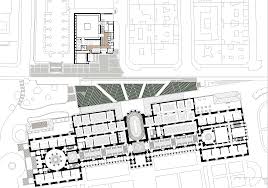
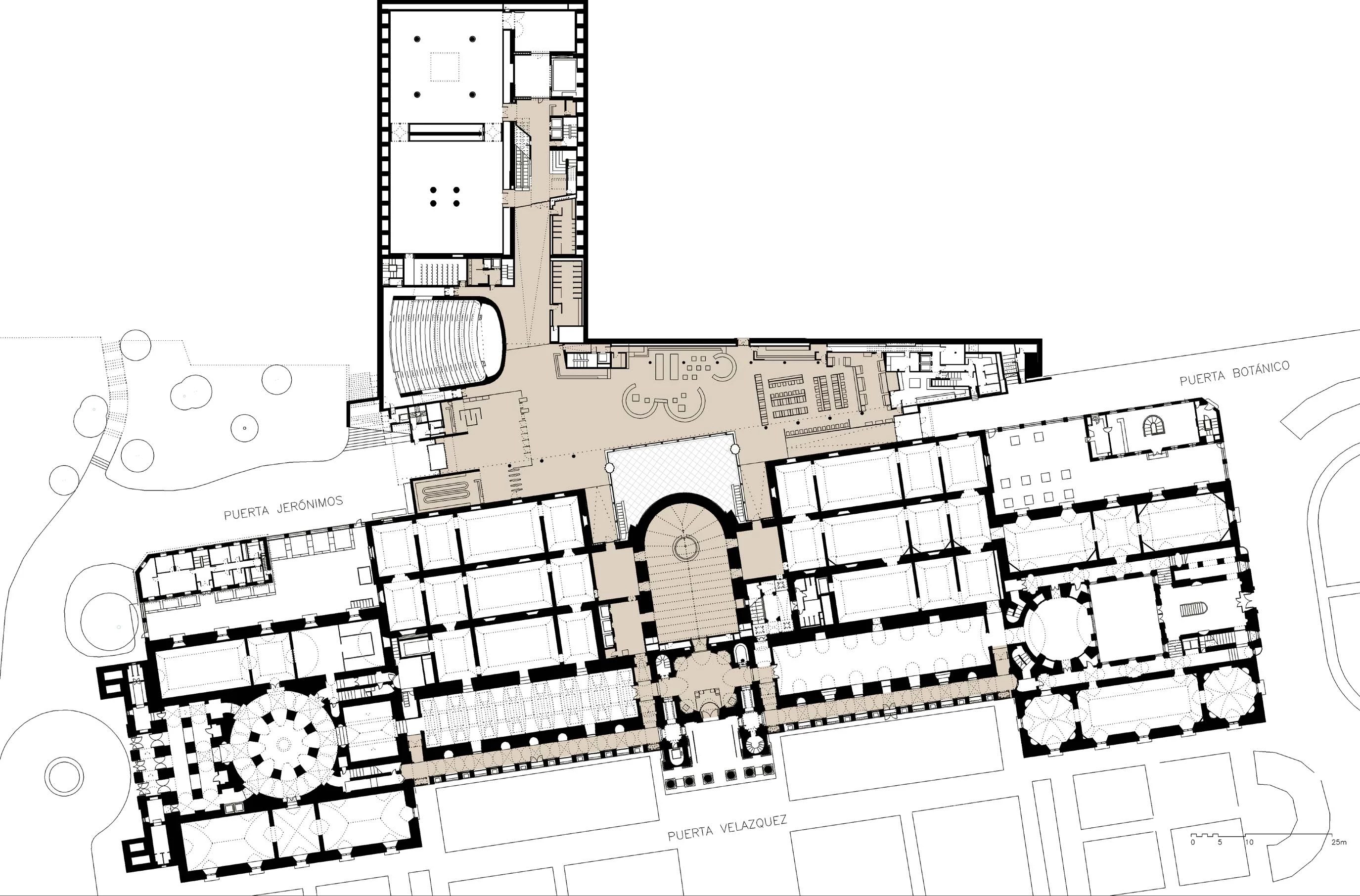
So, the Prado Museum (18th century) was originally not a museum but a the Academy of Natural Sciences. Only later King Fernando VII transformed the project to incorporate the painting collections from the Austria’s and the Bourbons. The new extension to the museum is from 2007 by the Spanish architect Rafael Moneo. It is located in the back of the original building, integrating into the museum the abandoned cloister of San Jerónimo del Real Church (1612). Underneath the cloister Moneo projected a three-story skylight as the central space for the temporary exhibitions that we do visit in the 4h full tour, worth seeing.

The Ritz Hotel is an early 20th century (1914), where we see how the classic French style was very fashionable those days. Same thing for the Palace Hotel built in 1912, both grand hotels designed by French architects (by Mevves).
El Casón del Buen Retiro fue concebido originalmente como un salón de baile dentro del Palacio del Buen Retiro, diseñado por Alonso Carbonel, según Memoria de Madrid y el Museo del Prado. Se construyó en 1637, como parte del Palacio del Buen Retiro, y es uno de los pocos elementos que aún se conservan de aquel conjunto arquitectónico.
Los jardines del Buen Retiro fueron creados por Felipe IV en el siglo XVII (como un regalo del Conde-Duque de Olivares a Felipe IV) como finca de recreo para los reyes de la Casa de Austria. Durante los reinados de los reyes de la Casa de Borbón, en los siglos XVIII y XIX , el Real Sitio y su entorno se enriquecieron con nuevas instalaciones. Carlos III fue quien, en 1767, permitió el acceso del público a estos jardines, aunque no fue hasta 1868 que el Ayuntamiento lo adquirió y lo convirtió en un parque público tal como lo conocemos hoy en día.
El Jardín del Parterre se construyó durante el reinado de Felipe V (1724-1746) en el emplazamiento de otro jardín, el Jardín de las Ocho Calles u Ochavado, formado por 8 calles que se cruzaban en una plaza circular. Aquí se encuentra el Ciprés Calvo (Taxodium distichum), el árbol más antiguo de Madrid, con una edad que se estimaba de unos 400 años, aunque estudios recientes sitúan su edad en los 200 años.
Este ciprés también conocido como el ahuehuete, es originario de México, y es conocido por su longevidad y su tronco robusto. Es un ejemplar singular y se cree que fue plantado en torno a 1632, coincidiendo con la creación del Palacio del Buen Retiro y los primeros jardines. Una leyenda popular cuenta que sobrevivió a la tala de árboles durante la invasión francesa, ya que su tronco sirvió para apoyar piezas de artillería.
Angel Caido del Retiro: La escultura “Ángel Caído” (1885)de Ricardo Bellver, ubicada en el Parque del Retiro de Madrid, mide 2,65 metros de altura. Esta estatua, que representa a Lucifer tras su caída del cielo, se encuentra sobre un pedestal que forma parte de un conjunto mayor, la Fuente del Ángel Caído, que tiene unas dimensiones aproximadas de 10 metros de largo, 10 de ancho y 7 de alto. Además de su altura, la escultura es conocida por estar ubicada a 666 metros sobre el nivel del mar, un detalle que ha generado diversas interpretaciones simbólicas.
Palacio de Cristal (1887) ejemplo destacado de la arquitectura de cristal y hierro, clasificado como arquitectura industrial, en Madrid. En la actualidad es una de las sedes del Museo Reina Sofía. Construido por Ricardo Velázquez Bosco en 1887 para la Exposición General de las Islas Filipinas, una exposición de exaltación colonial del Imperio español. El palacio se inspiró en el Crystal Palace, levantado en el Hyde Park de Londres en 1851 por Joseph Paxton. Otras obras de Ricardo Velázquez son: Palacio de Velázquez (1881-1883 Parque del Retiro), Ministerio de Agricultura (1897, Madrid), Fachada oeste del Casón del Buen Retiro (Madrid).
Monumento a Alfonso XII (1902 concurso nacional), ganador arquitecto José Grases Riera, donde destaca la columna central de 30 metros de alto con mirador sobre la que se sitúa su escultura equestre. Termina las obras Teodoro Anasagasti. Se inagura en julio 1922.
Castellana During the 18th century, noble families started to built palaces surrounded by gardens, like the
- Buenavista Palace (finales XVIII century 1777) of neoclasic style, which now is the Headquarters for the Spanish Land Army Headquarters
- Linares Palace (1877 – 1900) neobarroque. The legend says that it was enclosing the phantoms of the first Marquises of Linares and a girl who ws their dourghter. After being closed for more than a century with no use, it was reopened in 1992 as the House of America
CIBELES square/ round about. In the center we find Madrid’s most popular fountain, also from the 18th century. It is one of the cities mayor symbols, with the Cibeles Goddess ridding a chariot pulled by lions
- The Bank of Spain (late 18th century) of eclectic style (modelos manieristas italianos y arquitectura parisina del siglo XVII) founded by Carlos III, also known as the polititian or the best mayor that Marid ever had, building extensión by Rafael Moneo
- Communication Palace (1919) by Antonio Palacios.
Antonio Palacios’ Role in the Urban Development of Madrid
Antonio Palacios was a prominent architect in Spain. He was influential during the first half of the 20th century. He was responsible for some of the most emblematic buildings in Madrid. His work helped transform the old Baroque town into a modern metropolis.
Antonio Palacios designed and constructed many projects and buildings throughout Madrid. The most important ones are located in the Gran Vía and along the axis of the Alcalá Street. Here, we find three of the most spectacular and central pieces of his work. They are the Circle of Fine Arts, Commercial Industrial Bank, and the Communication Palace. All three were built by Palacios between 1907-17. We will visit them in depth, including their interiors.
Here, the goal was to alter the street scale. It also aimed to change the public spaces between the buildings that Antonio Palacios designed and constructed. His strategy was to build a sequence of monumental buildings. This would transform the overall scale of the streets. It would also enlarge the public space left in between. All monumental spaces that will give you a very different and impressive perspective of Madrid’s most brilliant modern period.
The result are grand spaces and grand public spaces. Antonio Palacios played a key role in transforming Madrid. His work helped make Madrid one of the main and more modern European cities.
Gran Vía was inaugurated In 1910. Designed by Fransico Andres Octaio Palacios (Antonios Palacios father). Starting in Alcalá Street, finishes in Plaza de España. The Gran Via means Great Route in Spanish. It was built as a fast connection for districts developed in the Project Ensanche. This route links the Arguelles district on the west with the Salamanca district to the east.
At the intersection of Alcalá Street and Gran Vía, we find the Metropolis Building. It was designed in the early 20th century by French architects.
Telefónica Bldg (1930) also known as Europe’s and Spain’s first skyscraper, combines elements of modern architecture with Baroque and neoclassical influences. Its design, inspired by New York skyscrapers, reflects a transition toward modern architecture in Madrid.
On January 1, 1930, the construction of the Telefónica building on Gran Vía was completed. The project was carried out by Luis Ignacio de Cárdenas, architect of the Telefónica company, who completed it within three years, following the parameters of the great North American skyscrapers and the premises of International Telephone and Telegraph (ITT), an American company involved in the creation of the Telephone Company in 1924.
Sol y el Oso y el Madroño. Según los historiadores, el origen de este escudo es similar al de otros medievales, y se remonta al siglo XII, cuando comenzaron a utilizarse como insignia bélica para distinguir a unos caballeros de otros. Fue utilizado por primera vez por parte de las tropas madrileñas en las campañas contra los musulmanes en Andalucía.
¿Por qué un oso? Cuenta la leyenda que se eligió un oso como emblema en homenaje a un oso pardo que el rey Alfonso XI cazó en uno de los montes cercanos a la capital. En aquel entonces, era fecuente que estos animales vagaran por las inmediaciones de la ciudad. La polémica se ha desatado en torno al sexo del animal. Y es que, según sostenía hace unos años el director del Archivo Histórico de la Villa, antaño el blasón de del Concejo llevaba una osa sobre un campo blanco. En heráldica, las hembras eran el símbolo de la fecundidad y la abundancia.
¿Y el madroño? El oso estaba al principio unido a una torre, que sería sustituída posteriormente por un madroño. Estos árboles eran habituales en las afueras de la ciudad durante toda la época medieval. No obstante, el origen de este símbolo se remonta a un hecho concreto ocurrido en el siglo XIII. En aquel entonces se produjo una disputa entre la Villa y el cabildo de la clerecía de Madrid sobre la propiedad de ciertos terrenos que ambos reclamaban. Finalmente, se consiguió llegar a un acuerdo por el que la Villa se quedaba con los territorios arbolados y el cabildo con los sitios de pasto. Por ello, se decidió incluir este árbol en el emblema de al ciudad. Además, se decidió situar al oso en actitud de comerse las hojas porque, según se creía entonces, estas eran un buen remedio contra la peste.
La corona y las estrellas: Las siete estrellas incrustadas en la banda azul, simbolizan la Osa Mayor, que, como ya hemos mencionado, era otro de los símbolos de la capital. Esta constelación es más conocida como el «Carro», debido a la forma que surge de unir los puntos mientras se las contempla desde el suelo terrestre. Por último, el escudo se remataría con la Corona, símbolo de la Monarquía, que se añadiría en 1544. La ciudad recibiría a partir de entonces el título de Coronada Villa de Madrid.

 Pure Expeditions